
Official guide · Finding Needle in the Stack
How the metal detector works
The detector is the tool that turns "I have no idea where to dig" into "I think it is over there". It is simple to use, but a little knowledge of how it works makes you much better with it.
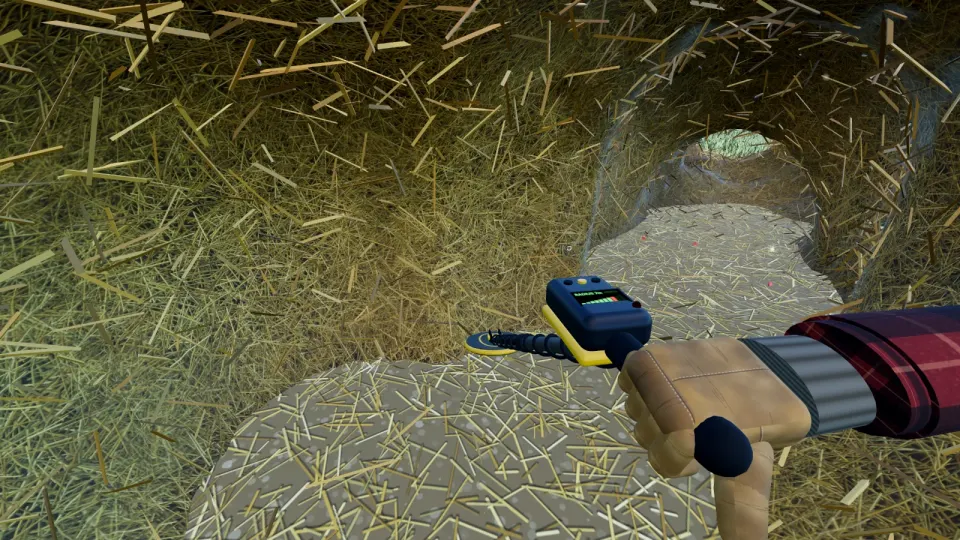
The beeping rule
The detector looks for the closest piece of metal inside its range. The closer it is, the stronger the signal, on a scale where 0 means "at the very edge of range" and 1 means "right on top of it". The beeps follow that number:
- At the edge of its range, the detector beeps roughly once a second.
- Right on top of metal, it beeps about 14 times a second, which sounds almost like a continuous tone.
- Between the two, the beeps get faster in a smooth way as you get closer.
Your ears become the instrument. You do not need to look at the screen to hunt, only to listen.
The four levels
| Model | Price | Range | Can spot the needle |
|---|---|---|---|
| Detector Mk I | $250 | 2 m | No |
| Detector Mk II | $1,400 | 4 m | No |
| Detector Mk III | $7,000 | 7 m | Yes |
| Detector Mk IV | $32,000 | 12 m | Yes |
Range is how far away metal can be and still be heard. Doubling the range does not just mean "twice as far": it means a much larger volume of hay is covered with every sweep. The big step in usefulness is Mk III, because that is the first level that can tell the needle apart from ordinary junk.
Telling the needle apart
Before Mk III every metal object sounds the same. After it, the detector's screen and sound change when the thing it is pointing at is the needle. When you see that, stop digging at random and dig carefully straight toward it. The needle sparkles once it is uncovered. There is more in How to find the needle.
What it cannot find
Diamonds are the only valuable that is not metal, so the detector cannot hear them. Everything else you can find, from nails to gold rings, does show up. That is one more reason to look around as you dig and not rely on your ears alone.
A simple technique
- Stand still and turn slowly in a full circle. If you hear nothing, move.
- When you hear a beep, turn until it is fastest. That is the direction of the closest metal.
- Step toward it and repeat. Each step should make the beeps faster.
- When it is almost a steady tone, dig right where you are standing.
The same idea, following a signal that gets stronger as you get closer, is how many real search methods work. A short article on that is Needle in a haystack in computer science.
Ready to dig?
Free in your browser on PC and mobile. Your progress saves as you play.
Play Finding Needle in the Stack